Understanding Risk
"We are spectacularly bad at understanding risk. Not because we are careless or unintelligent — but because the human brain was never designed to assess probability accurately. And in high risk environments, that cognitive limitation kills people."
"The most dangerous moment in any organisation is not when something goes wrong. It is when everything has been going right for so long that people stop believing anything can go wrong. That is not confidence. That is the most lethal form of risk misunderstanding there is."
Risk is the most researched concept in the history of human psychology. We have been studying it for generations— in laboratories, in boardrooms, in casinos, on mountain faces, and in the aftermath of industrial disasters. And after all of that research, one finding stands above all others.
We are terrible at it.
Not occasionally. Not in edge cases. Systematically, predictably, and consistently terrible at assessing the probability and consequences of the risks we face every day. And the most confronting part of that finding is that expertise does not fix it. Experience does not fix it. Intelligence does not fix it. Because the problem is not knowledge. The problem is the architecture of the human brain itself.
The brain was designed for a world of immediate, visible threats. A predator in the grass. A storm on the horizon. It was not designed for a world of latent system failures, accumulated procedural drift, and low-probability high-consequence events. It was not designed to assess the risk of something that has never happened before — or something that has not happened for so long that people have stopped believing it can.
This is what Transformational Safety® calls Inadvertent Ignorance — the state of not knowing what you do not know, and having no awareness that the gap exists. It is not negligence. It is not carelessness. It is the predictable outcome of a brain doing exactly what it was designed to do.
The problem is that in high risk environments, that rapid judgement is almost always wrong in the most dangerous direction. We underestimate the likelihood of things that have not happened recently. We overestimate our ability to respond when they do. And we systematically ignore the weak signals that precede every major failure — because they do not look like danger. They look like normal.
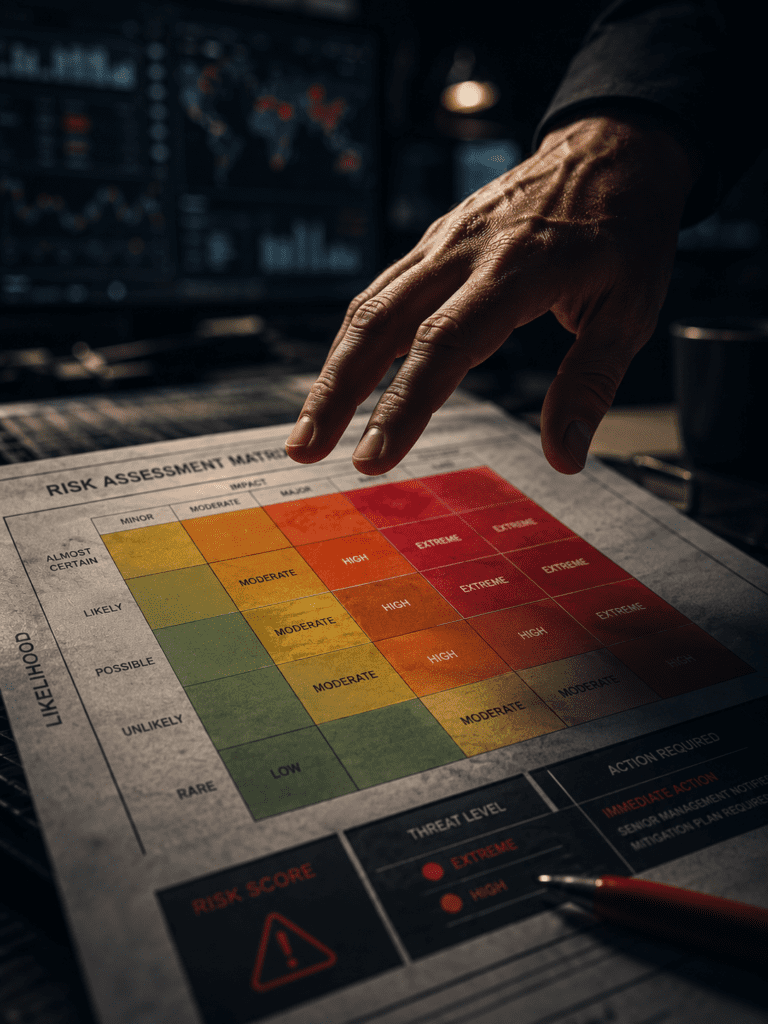
Understanding risk — genuinely understanding it, not just completing the risk matrix — requires an organisation to confront some deeply uncomfortable truths about human cognition. It requires leaders who are willing to challenge their own assumptions, question their own experience, and build systems that compensate for the predictable failures of human risk perception.
The Risk Room is where that confrontation happens. It is an experiential program developed by Transformational Safety® that takes participants through a structured exploration of their own risk perception — exposing the cognitive biases, heuristics, and mental shortcuts that are quietly shaping every safety decision they make.
It does not tell people they are wrong. It shows them — in a way that is impossible to dismiss or rationalise away. And that experience changes the way they see risk for the rest of their career.
"We underestimate the likelihood of things that have not happened recently. We overestimate our ability to respond when they do. And we systematically ignore the weak signals that precede every major failure — because they do not look like danger. They look like normal."