
Beyond Compliance
Reader Resources
Interactive tools to support your leadership development and turn the ideas in the book into practical reflection.
Explore your leadership identity and strengths, examine psychological safety, and reflect on the principles of High Reliability Organising.
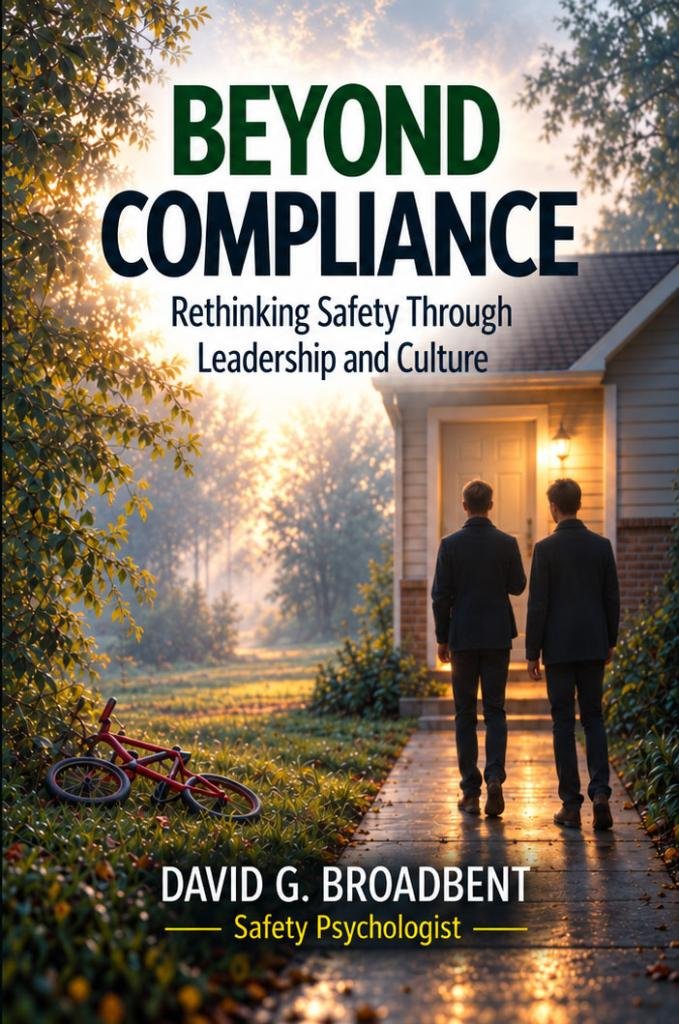

Most organizations that suffer a catastrophic safety failure were not ignoring safety. They believed they were managing it well. Their systems were certified, their training records were current, and their injury rates were falling. And still, one morning, two people walked up a quiet footpath to tell a family that someone was not coming home.
Beyond Compliance is about the gap between how safe an organization looks and how safe it actually is, and about the leadership that closes it.
Drawing on more than two decades of work with high-hazard industries around the world, Safety Psychologist David G. Broadbent shows why safety management systems, however well designed, cannot on their own produce safe operations. The real determinants of safety lie in culture, belief and the everyday decisions of leaders.
Inside, you will find:
- Why compliance creates the illusion of safety, and how organizations come to believe they are safe when they are not
- The difference between safety as a priority, which bends under pressure, and safety as a value, which holds
- Psychological safety as the condition beneath every safety culture, and why speaking up achieves nothing without leaders who listen
- The nine Transformational Safety® Leadership archetypes, from the Invisible Man to the Missionary, and what each one produces in a workforce
- The Transformational Safety® Integrated Model and Cultural Stability Theory: why defenses fail when they move, and how culture holds them still
- High Reliability Organizing, and what the organizations that fail least actually do differently
- The Trust Equation, and why Zero Harm targets can undermine the very trust they are meant to build
- A five-level safety culture maturity model, practical methods for assessing culture and leadership across an organization, and a clear path from assessment to lasting change
Written for executives, managers, supervisors and safety professionals in mining, energy, construction, aviation, healthcare and every industry where getting it wrong costs lives, Beyond Compliance asks one question of every leader: is the safety culture you have built good enough to protect the people who work within it?
If you suspect the answer is not yet, this book is where the work begins.
Explore the Reader Resources
Work as Imagined, Work as Done
Explore the gap between how work is designed and how it is actually done, and reflect on whether your safety system is living or has become a set of manuals on a shelf.
Chapters 1 and 2 | Pages 1–30
Psychological Safety
Examine how effectively your workplace encourages speaking up, learning from mistakes, challenging assumptions and raising safety concerns without fear.
Chapter 6 | Page 63
Transformational Safety® Leadership
Explore the nine Transformational Safety® Leadership constructs, from the Invisible Man to the Missionary, and reflect on which ones shape how you lead safety.
Chapter 10 | Page 105
High Reliability Organizing
Explore the principles of High Reliability Organizing and assess how your organization anticipates, recognizes and responds to emerging risks.
Chapter 12 | Page 125
The Trust Equation
Explore credibility, reliability, intimacy and self-orientation, the four elements of trust, and reflect on which one is holding trust in safety leadership back.
Chapter 15 | Page 165
Safety Culture Maturity
Explore the five levels of the Transformational Safety® Culture Maturity Model, from Lethal to Transformational, and reflect on where your organization's culture sits today.
Chapter 17 | Page 193
ATLAS Leadership Development
Explore the seven pillars of authentic safety leadership, from understanding your identity and values to developing the skills needed to lead meaningful organizational change
Chapter 19 | Pages 219–222
Work as Imagined, Work as Done
Chapters 1 and 2 — The System Performs; Virtual Safety Systems: Manuals on Shelves, not Behaviours in Practice | Pages 1–30
Every safety system is a theory about how work is done. Work-as-Imagined is fixed at the moment the system is designed; Work-as-Done adapts, every day, to the real conditions of the job. The gap between them is not negligence, but it is where risk lives, and a system can be thoroughly documented, regularly audited and still be little more than manuals on a shelf.
This reflection looks at eight aspects of the safety system where you work, from how procedures match practice to how leaders know what is really happening, and shows where your system is living and where it has become virtual. It also gives you questions to ask at the work face this week.
The purpose is reflection and improvement, not scoring or judging individuals.
Psychological Safety
Chapter 6 — The Condition Beneath the Culture: Psychological Safety | Page 63
Psychological safety is the foundation of a culture in which people feel able to speak up, question decisions, acknowledge mistakes and raise concerns without fear of embarrassment or punishment.
This reflection tool invites you to examine the everyday behaviours and leadership practices that either strengthen or undermine psychological safety in your workplace.
The purpose is reflection and improvement, not scoring or judging individuals.
Transformational Safety® Leadership
Chapter 10 — The Transformational Safety® Leadership Constructs | Page 105
The Transformational Safety® Leadership framework describes nine constructs: behavioural accounts of how leaders actually show up in the safety cultures they shape. They are not personality types.
This self-assessment gives you a first view of your own profile across the nine. Treat it as a starting point for reflection. The most accurate picture of your leadership comes from the people you lead, which is why the full Transformational Safety® Leadership assessment is a 360-degree instrument.
The purpose is reflection and improvement, not scoring or judging individuals.
High Reliability Organizing (HRO)
Chapter 12 — What Safe Organizations Actually Look Like: High Reliability Organizing | Page 125
High reliability organizations work in conditions where small errors can escalate quickly, yet they sustain remarkably safe performance. They do it through everyday habits: noticing weak signals, resisting easy explanations, staying close to frontline work, recovering quickly when things go wrong, and deferring to expertise rather than rank.
This reflection tool invites you to consider how strongly these practices show up in your own team and organization.
The purpose is reflection and improvement, not scoring or judging individuals.
The Trust Equation
Chapter 15 — Belief, Zero Harm, and the Psychology of Credibility | Page 165
Trust, as Chapter 15 applies it to safety leadership, is the sum of three things, credibility, reliability and intimacy, divided by a fourth: self-orientation. Each element fails for different reasons and has a different remedy, and self-orientation, the one leaders find hardest to see in themselves, can undo the other three.
This reflection shows where trust in safety leadership is strong and where it is being held back. You can complete it about yourself, or about a leader you work with, and compare the two.
The purpose is reflection and improvement, not scoring or judging individuals.
Safety Culture Maturity
Chapter 17 — The Maturity Journey: From Lethal to Transformational | Page 193
Every organization's safety culture sits somewhere on a journey from Lethal, through Avoidant, Developing and Functional, to Transformational. Culture is rarely even. It can be mature in one area and fragile in another, and the gaps are often where the next serious event is waiting.
This reflection tool asks you to describe what actually happens in your organization across eight aspects of culture, from how bad news is handled to how safety holds up under pressure. Your report shows where each aspect sits on the maturity journey and gives practical next steps matched to your answers.
The purpose is reflection and improvement, not scoring or judging individuals.
ATLAS Leadership Development
Chapter 19 — The Transformational Safety System | Pages 219–222
ATLAS develops safety leadership through seven pillars, completed in sequence. The pillars move from understanding yourself as a leader, through your motivation, emotional intelligence, strengths and challenges, to your capacity to absorb change and put it into practice.
Choose a pillar below to open its reflection. We recommend working through them in order, beginning with Pillar 1.
The purpose is reflection and improvement, not scoring or judging individuals.