
The Collective Mindfulness Survey
Collective mindfulness focusses on open communication, active listening, and empathy. As group members become more present and engaged during interactions, misunderstandings decrease, and trust flourishes. This, in turn, nurtures an inclusive environment where diverse perspectives are valued and innovative solutions arise.
Studies have shown that teams or communities practicing collective mindfulness experience improved decision-making, reduced conflicts, and increased overall well-being. It also fosters a greater sense of belonging, motivating individuals to contribute their best efforts to common goals.
To implement collective mindfulness effectively, leaders play a pivotal role in setting the tone and modeling mindful behavior. When leaders embrace mindfulness, it empowers others to follow suit, creating a culture where collective mindfulness can flourish.
The Transformational Safety® Collective Mindfulness (HRO) Personal Awareness Instrument has been specifically developed as a companion tool to the Transformational Safety® Culture Survey. Whilst the Transformational Safety® Culture Survey provides a very empirically sound and detailed analysis of the contemporary safety culture operating within a business, the Transformational Safety® Collective Mindfulness (HRO) Personal Awareness Instrument allows individuals to gain a personal understanding of where they see their organisation placed against the five (5) hallmarks of High Reliability Organizing (HRO).
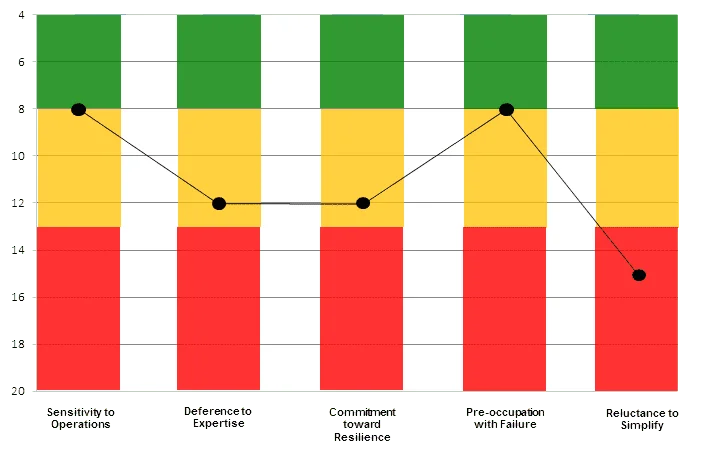
Evidence shows that the consistent application of the HRO Hallmarks (within the green zones) acts as an enormously significant contribution towards the development and sustainability of positive safety decisions/behaviours within all operations. It does so by maximizing the likelihood of identifying toxic system deviations early (at the point of “just discernible”), and applying “positive variance” to bring things back toward a safety aware balance. The application of the HRO Hallmarks can add a level of flexibility and adaptability to an organisation, leading them toward the goal of “living resilience” within their underlying safety culture.
Here is a reminder about what the five (5) HRO Hallmarks represent:-
- Preoccupation with Failure: HROs proactively identify and address potential failures or weaknesses before they lead to significant problems, emphasizing a prevention mindset.
- Reluctance to Simplify: HROs recognize the complexity of their operations and avoid oversimplifying issues, valuing comprehensive analysis and understanding.
- Sensitivity to Operations: HROs promote open communication and encourage employees to report concerns and near-miss incidents, fostering a culture of constant vigilance.
- Commitment to Resilience: HROs prioritize building resilience in their systems and workforce, training employees to adapt and recover quickly from unexpected events.
- Deference to Expertise: HROs value the expertise of their employees and provide them with decision-making authority based on their knowledge and experience, fostering a culture of trust and autonomy.
Here is an example of a standardized individual response profle.
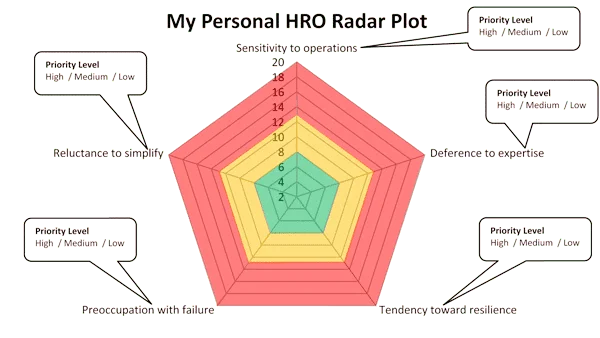
 By taking full advantage of the Radar Plot technologies embedded within the scoring matrices of the Collective Mindfulness Survey (Development Edition) participants shall be able to intuitively recognize where they, and their organizations, may need to focus more energy and attention.
 If you would like to review what the US Department of Veterans Affairs (USVA) thinks about the value of HRO click here.

"Most organisations wait until the system fails catastrophically before they act. High Reliability Organisations don't wait. They are preoccupied with failure before it happens — hunting for the signal in the noise at the point where it is just discernible. That is not pessimism. That is the highest form of safety intelligence."